




Social media and messaging apps are the leading channels for scams targeting Indonesian banking customers, a new BioCatch survey finds.
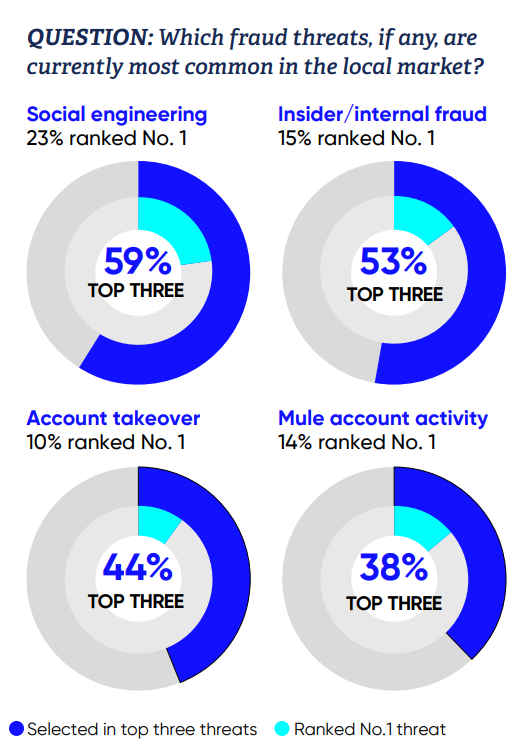
The survey of 100 banking leaders found that 59 percent ranked social engineering among their top three fraud threats, with 23 percent identifying it as their biggest concern.
Social media was among the top three scam channels cited by 52 percent of respondents, followed by messaging apps such as WhatsApp and Telegram at 51 percent.
Some 43 percent reported rising fraud attempts at their institutions, while 42 percent saw increasing losses.
Banks Struggle to Detect Manipulated Customers
Nearly half (45 percent) of respondents identified difficulty distinguishing genuine customers from those being manipulated by scammers as a major operational challenge.
Half also cited coached customer journeys as a fraud-detection gap, with 19 percent ranking it as their biggest weakness.
These involve scammers guiding legitimate customers through transactions, making fraud harder to detect.

BioCatch Director of Global Fraud Intelligence Thomas Peacock said,
“More than four in five respondents consider their existing controls effective, even as social engineering dominates their concerns and identifying manipulated customers remains their biggest operational challenge.
Banks cannot afford to mistake the effectiveness of their existing controls for readiness against emerging threats. Fraudsters continually change their methods, and banks must evolve just as quickly.”
The survey found that 42 percent of respondents said their banks were evaluating new fraud-prevention solutions, while 13 percent were procuring or implementing them. Another 40 percent were considering upgrades.
Other challenges included detecting money mule accounts, managing high alert volumes and dealing with fragmented systems, each cited by 40 percent of respondents.
Banks Assess Payment Security Readiness
Nearly two-thirds (63 percent) considered their banks fully or mostly prepared for QRIS and BI-FAST security requirements and growing fraud-liability expectations.
Another 35 percent reported being only partially prepared.

BioCatch Global Advisory Director Subhashish Bose said,
“As instant payments become an increasingly central part of everyday life, fraud prevention must operate at the same speed as the transactions it protects.
That requires recognising the behavioral signs of manipulation as they emerge, even when the customer and the transaction appear entirely legitimate.”
The survey also found that 42 percent of respondents said their banks handled scam victim reimbursements on a case-by-case basis, 27 percentage points higher than the next-highest market surveyed.
BioCatch surveyed 1,200 banking leaders across 12 markets, including 100 in Indonesia, between 15 December 2025 and 6 January 2026.
Featured image: Edited by Fintech News Indonesia, based on image by 3DdarkZone via Magnific
